Deployment analysis ·
PKI and protocol upgrade costs
If RSA-2048 broke in 2030, which keys would still need replacing? Follow the surviving CA keys, the algorithms issuers are choosing, and the cost of a larger handshake.
If RSA breaks on a given date, how many CA keys are left to replace?
Suppose recovering an RSA private key becomes practical for ordinary moduli up to X bits. A client that still trusts such a CA key could accept forged certificates within its authority. If that happened on 1 January 2030, this cohort would still have 117 distinct keys exposed to a break through 2,048 bits. A break through 3,072 bits would reach 416 keys. Through 4,096 bits it would reach 741.
Chrome TLS roots and intermediates present on 16 November 2026
- ≤ 2,048 bits
- ≤ 3,072 bits
- ≤ 4,096 bits
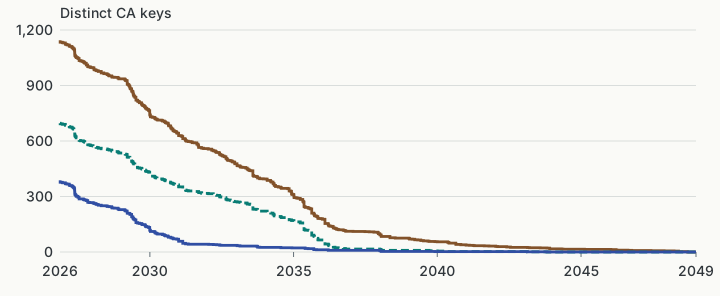
| RSA break through | Distinct keys | Root keys | Intermediate keys | Certs |
|---|---|---|---|---|
| RSA-2048 | 117 | 11 | 111 | 131 |
| RSA-3072 | 416 | 11 | 410 | 430 |
| RSA-4096 | 741 | 61 | 700 | 793 |
Each step removes a key the day after its last certificate in the snapshot expires. Cross-signing can put the same key in both roles. At the snapshot date, a break through 2,048 bits would affect 380 distinct keys across 401 certificates. In the 2030 RSA-2048 example, five keys appear as both roots and intermediates, so the 11 root keys and 111 intermediate keys represent 117 distinct public keys. We identify keys by the SHA-256 fingerprint of their SubjectPublicKeyInfo.
What would actually need replacing? Clients must withdraw affected trust wherever they still accept it. An issuer that needs to keep operating must move to a sound key, reissue affected descendants and distribute a working chain. A retired hierarchy can simply be distrusted. The chart counts subject keys in this fixed public CA cohort. Early distrust can reduce the exposed population, a locally installed anchor can remain trusted past expiry, and new issuance or key reuse can extend exposure. The chart omits website keys, private PKIs and the potentially much larger number of child certificates that would need new signatures.
Download the chart (SVG) · Inventory and certificate-level data
Are new CA certificates still using RSA?
Yes, including RSA-2048. Of the 358 intermediate certificates in the snapshot whose validity began in 2026, 213 contain RSA keys (59.5%) and 145 contain EC keys for ECDSA (40.5%). The 36 RSA-2048 certificates contain 36 distinct keys. For 35 of them, no earlier certificate in this snapshot has the same key.
| Cohort | RSA-2048 | RSA-3072 | RSA-4096 | ECDSA | EC share |
|---|---|---|---|---|---|
| 2022 | 11 | 41 | 50 | 82 | 44.6% |
| 2023 | 25 | 40 | 31 | 54 | 36.0% |
| 2024 | 22 | 60 | 58 | 80 | 36.4% |
| 2025 | 52 | 104 | 97 | 166 | 39.6% |
| 2026 YTD | 36 | 53 | 124 | 145 | 40.5% |
The EC share of the surviving intermediate cohort was 40.0% for 1 January–16 November 2025 (161 of 402), versus 40.5% for the same period in 2026. RSA-4096 was the most common RSA size in the 2026 cohort. Among the included roots, the 2024 cohort contained one RSA-4096 and one P-384 root. No included root had a 2025 or 2026 start date.
Start of validity approximates issuance. A renewal or cross-signature counts as another certificate, and the first appearance of a key here does not establish its generation date. Older cohorts exclude certificates that expired or left the selected trust population before the snapshot. These are counts of surviving CA certificates, so they cannot establish the historical issuance rate of the entire Web PKI.
What is happening at the website level?
Cloudflare Radar’s Certificate Transparency public-key breakdown gives a separate view of recent logging activity. For 22–23 February 2026 it displayed about 22 million RSA and 22 million ECDSA entries. For 22–23 August it displayed about 38 million RSA and 49 million ECDSA entries. ECDSA led in the August window while RSA issuance continued at scale. These rounded observations include CT activity such as precertificates. They do not count unique websites or distinguish RSA modulus sizes. Two short windows alone cannot establish a sustained trend. February CT breakdown · August CT breakdown
What is the migration plan for signatures?
The production CA snapshot contains zero standalone ML-DSA or composite ML-DSA subject keys. Microsoft is testing ML-DSA certificate chains in a controlled TLS pilot. For X.509 deployments, RFC 9881 specifies standalone ML-DSA and RFC 10073 specifies composite signatures that require both ML-DSA and a traditional component such as ECDSA or RSA. Those specifications make the encodings interoperable. Acceptance also requires support from the relevant trust program and clients. ECDSA can be a migration target for an RSA-specific factoring advance. A quantum break using Shor’s algorithm also threatens elliptic-curve discrete logarithms, so it calls for a post-quantum authentication path. Microsoft pilot · Standalone ML-DSA · Composite ML-DSA
Chrome is exploring Merkle Tree Certificates, which let one signed tree head authenticate many certificates. Let’s Encrypt targeted a staging environment for late 2026 and a production-ready environment for 2027. These are program-specific targets. Hybrid ML-KEM key exchange can already be negotiated independently of the certificate algorithm, so a connection using post-quantum key exchange can still rely entirely on RSA or ECDSA for authentication. Chrome roadmap · Let’s Encrypt plan · November implementation update
Which keys do clients still trust?
In a snapshot of the Common CA Database (CCADB), every selected public TLS root and intermediate had an RSA or elliptic-curve (EC) public key. The database listed 77 roots and 129 intermediate certificates whose encoded validity extended at least another decade.
| CA role | RSA | EC | ML-DSA | Certificates | Distinct keys |
|---|---|---|---|---|---|
| Root | 68 | 32 | 0 | 100 | 100 |
| Intermediate | 1,164 | 694 | 0 | 1,858 | 1,748 |
A hypothetical minimum of RSA-3072 would require new subject keys for 17 RSA-2048 root certificates and 384 intermediates. A P-384 minimum would affect three P-256 roots and 342 intermediate certificates. The issuer also matters. Of the 694 EC intermediates, 80 carried an RSA signature. Even a service with a strong leaf key can depend on the algorithm that signed its issuing CA.
Counts are distinct certificate fingerprints within each role, with repeated public keys counted once in the last column. The sample includes certificates within their validity dates, marked TLS-capable and Chrome “Included” (root) or “Trusted” (intermediate), with a blank or “Not Revoked” status. It measures registry entries. Client populations, traffic shares and enterprise-installed roots fall outside its scope. CCADB reports · Example cross-signed paths
Certificate and trust deadlines
View the expiry calendar, browser cutoffs and ML-DSA pilot dates
Eleven intermediates reach their encoded expiry by the end of 2026, and 189 do so by 16 November 2027. The busiest calendar year in this snapshot is 2029, with 345 intermediate and seven root expirations. A service still presenting an expiring intermediate needs a working successor path by its last valid instant.
- 23:59:59 UTC
- emSign Root CA - G1 · Chrome trust cutoff. The root certificate runs to February 2043. In applicable Chrome versions, newly logged TLS leaves need another eligible path after this cutoff. Earlier eligible leaves may continue to validate.
- 00:00:00 UTC
- Three Alibaba Cloud intermediates expire. GCC R3 DV TLS CA 2023, OV TLS CA 2023 and AlphaSSL CA 2023 share the first intermediate expiry. Alibaba had already announced a hierarchy change for September 2025. Issuer notice
- 13–31 Dec 2026UTC
- Eight more intermediates expire. Four cPanel certificates reach expiry on 13 December, three Trusted Secure certificates on 20 December and ACCVCA-120 on 31 December.
- 10:00:00 UTC
- GlobalSign Root CA - R3 reaches the first encoded root expiry. Its Chrome cutoff for newly logged leaves had already passed on 30 September 2026.
Of the 100 roots, 95 matched fingerprints in Chromium’s store v45. Of those, 44 had an earlier SCTNotAfter cutoff for Chrome 153.0.8010.0 and later. That date constrains when a qualifying leaf Signed Certificate Timestamp can be issued. A trust anchor is provisioned by the client, so its encoded expiry alone cannot establish a universal last day of service. The usable path depends on client policy, intermediate validity and alternative chains. Pinned Chrome store · Chrome root policy · X.509 path validation
ML-DSA in test hierarchies
Microsoft’s seven ML-DSA-87 pilot roots expire between 25 June and 9 July 2027. In Microsec’s test chain on 3 July 2027, the ML-DSA-65 intermediate expires at 13:59:59 UTC, five hours before its ML-DSA-87 root. DigiCert lists its X9 ML-DSA test roots through 10 September 2050. These dates describe separate test programs. The X9 production RSA and EC roots are listed through 12 June 2050. Microsoft pilot list · Microsec intermediate · Microsec root · DigiCert X9 repository
Where do the extra TLS bytes go?
Moving a full TLS 1.3 handshake to larger standardized profiles added 6,228 bytes across four messages. Most of the increase came from authentication. A client receives one KEM ciphertext, but two certificate keys and three signatures when the server sends a leaf, one intermediate and a fresh proof of possession.
The group changes from X25519/ML-KEM-768 to P-384/ML-KEM-1024. The KEM public key and ciphertext account for 864 additional bytes and the two classical shares add 130. Moving every signer from ML-DSA-65 to ML-DSA-87 adds 640 bytes per transmitted public key and 1,318 per signature. Changing only the root adds 1,318 bytes on the wire because the client already holds the root and receives its signature on the intermediate. Distributing the new root to clients is a separate rollout.
Measured message sizes for all four handshakes
| Hybrid group / ML-DSA | ClientHello | ServerHello | Certificate | CertificateVerify |
|---|---|---|---|---|
| X25519/768 · 65 | 1,365 | 1,210 | 11,057 | 3,317 |
| P-384/1024 · 65 | 1,814 | 1,755 | 11,057 | 3,317 |
| X25519/768 · 87 | 1,365 | 1,210 | 14,973 | 4,635 |
| P-384/1024 · 87 | 1,814 | 1,755 | 14,973 | 4,635 |
Each connection used one offered group, a locally trusted root, server-only authentication and no certificate compression. The counts exclude record and transport overhead. Download the measurement script
If attacks forced still larger parameters
The largest FIPS profiles are ML-KEM-1024 and ML-DSA-87. To explore pressure beyond those profiles, the model doubles or quadruples each encoded post-quantum object relative to ML-KEM-768 and ML-DSA-65. The last column counts two public keys and three signatures. It excludes names, classical shares, framing and other certificate fields.
| Profile | KEM key client sends | Ciphertext server sends | Authentication server sends |
|---|---|---|---|
| Reference · 768 / 65 | 1,184 | 1,088 | 13,831 |
| FIPS maximum · 1024 / 87 | 1,568 | 1,568 | 19,065 |
| 2× reference · modeled | 2,368 | 2,176 | 27,662 |
| 4× reference · modeled | 4,736 | 4,352 | 55,324 |
At 4×, the extra authentication bytes alone occupy about 332 ms on a 1 Mbit/s link. This is serialization time. End-to-end latency also depends on congestion, loss and processing. A new profile would need algorithm identifiers, implementations and peers that support it. Whether any larger parameters would restore security depends on the attack. ML-KEM sizes · ML-DSA sizes
Which protocols hit a limit first?
IPsec / IKEv2
The first IKE exchange precedes encrypted IKE fragmentation. Putting a larger KEM there risks IP fragmentation and packet loss. Negotiating an additional encrypted exchange lets the peers split the KEM across IKE fragments, at the cost of a round trip relative to basic IKEv2.
A strongSwan trace split a 9,120-byte authentication request into eight fragments. Quadrupling its post-quantum key and signatures would give about 34.2 kB, or at least 29 fragments at an illustrative 1,200 usable bytes each. Loss can force retransmission of the exchange. The extra bytes fall on tunnel setup or reauthentication. ESP data packets use symmetric cryptography. strongSwan trace · IKE fragmentation · Multiple key exchanges
WireGuard
Native WireGuard uses a fixed Curve25519 handshake, with a 148-byte initiation and 92-byte response. An external exchange can supply its optional 32-byte preshared key. A larger KEM in that exchange adds zero bytes to native handshake or data packets. Provisioning pays the bandwidth and startup cost. For example, doubling both ML-KEM-1024 objects in Mullvad’s documented exchange would add 3,136 bytes there. Native messages would need a protocol change to carry ML-KEM or ML-DSA directly. WireGuard layouts · Mullvad provisioning
SSH
The server places its host credential, KEM ciphertext and exchange signature in one SSH reply. With an ML-DSA-44 host key and CA key, two signatures and an ML-KEM-768 ciphertext, quadrupling those objects gives 34,208 bytes before framing. That exceeds the 32,768-byte payload every implementation must support. A raw pinned host key gives 19,280 post-quantum bytes in the same model. Receivers may accept larger packets, but TCP segmentation cannot raise a receiver’s SSH packet limit. SSH packet sizes · OpenSSH certificate format
TLS / QUIC
TLS over TCP can split the certificate flight across records and segments. A larger flight may have to wait for acknowledgments. A QUIC server sending to an unvalidated address also faces a 3× amplification limit. A single 1,200-byte client datagram allows 3,600 server bytes, already less than the reference authentication flight. Further client traffic or address validation allows the server to continue. QUIC address validation
What if larger keys cannot restore security?
A signature forgery changes who can authenticate. If an attacker can forge for a trusted RSA, ECDSA or ML-DSA root, clients may accept an attacker-issued chain. Recovery requires distributing a sound anchor and withdrawing the vulnerable trust from clients. For a broken intermediate, a surviving parent can certify a replacement. Clients must receive and enforce the retirement of the old issuer. A second valid path alone leaves the vulnerable path open.
A key-exchange break changes which traffic remains secret. If a break enables recovery of a session secret from a recorded exchange, replacing equipment later cannot protect the recording. A correctly combined hybrid exchange can retain confidentiality while an independent component remains secure. A signature break alone does not reveal the ephemeral secrets of earlier forward-secret sessions, though it can enable active impersonation on future connections. The certificate calendar describes planned replacement. A practical break moves the deadline forward to the point at which peers can no longer rely on the affected key or algorithm. PKI trust anchors · IKEv2 hybrid security considerations